
GuidesHow to analyze the training you program?
What counts as a set
Before splitting anything between muscles, the analyzer decides which sets count.
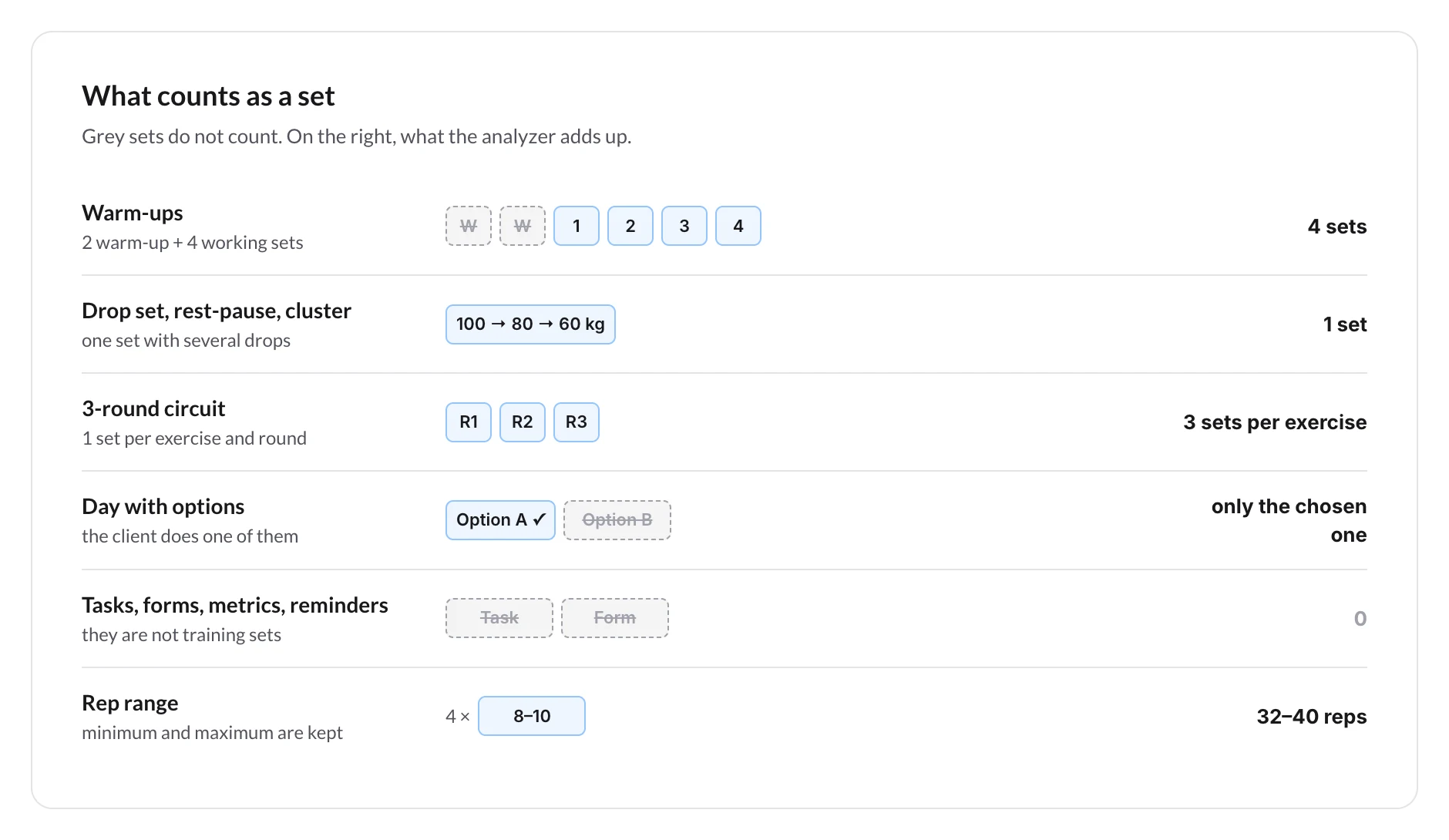
| Case | How it counts |
|---|---|
| Warm-ups | They don't count. |
| Drop set, rest-pause, cluster | A single set. |
| Superset | Each exercise, its own sets. |
| Circuit | Sets × rounds: 3 rounds of 1 set = 3 sets per exercise. |
| AMRAP without rounds | 1 round, with the Estimated rounds notice. |
| Day with options | Only one: in Performed, the one the client chose; in Planned, the chosen one or the first. |
| Tasks, forms, metrics, reminders | They don't count. |
Ranges and kilos
- Ranges: calculated with the minimum and the maximum. 4 ×
8–10reps give32–40; at 80 kg,2,560–3,200 kgof tonnage. - Pounds: converted to kilos.
- RPE, RIR, %1RM or bodyweight: count in sets and reps, not in tonnage (sets without kg).
Strength or Endurance
Each exercise goes to a mode based on its load mode: Reps to Strength; Time or Distance to Endurance. Without a load mode, it is decided by how its sets are prescribed.
Planned or performed
- Planned: what you prescribed.
- Performed: only completed sets, with what the client logged. If you prescribed 4 and they completed 3, 3 count.
Unclassified exercises and sets without kg
What the workout analyzer's sets-without-kg note and unclassified exercises notice mean, what is left out of each calculation and how to fix it.
How sets are split across muscles
How the workout analyzer splits each exercise's sets across muscles — primary 1 and secondary 0.5, the Zone, Muscle and Detail tree, and the highest-weight rule that prevents double counting.