
How sets are split across muscles
The analyzer splits each set according to the primary and secondary muscles on the exercise's card.
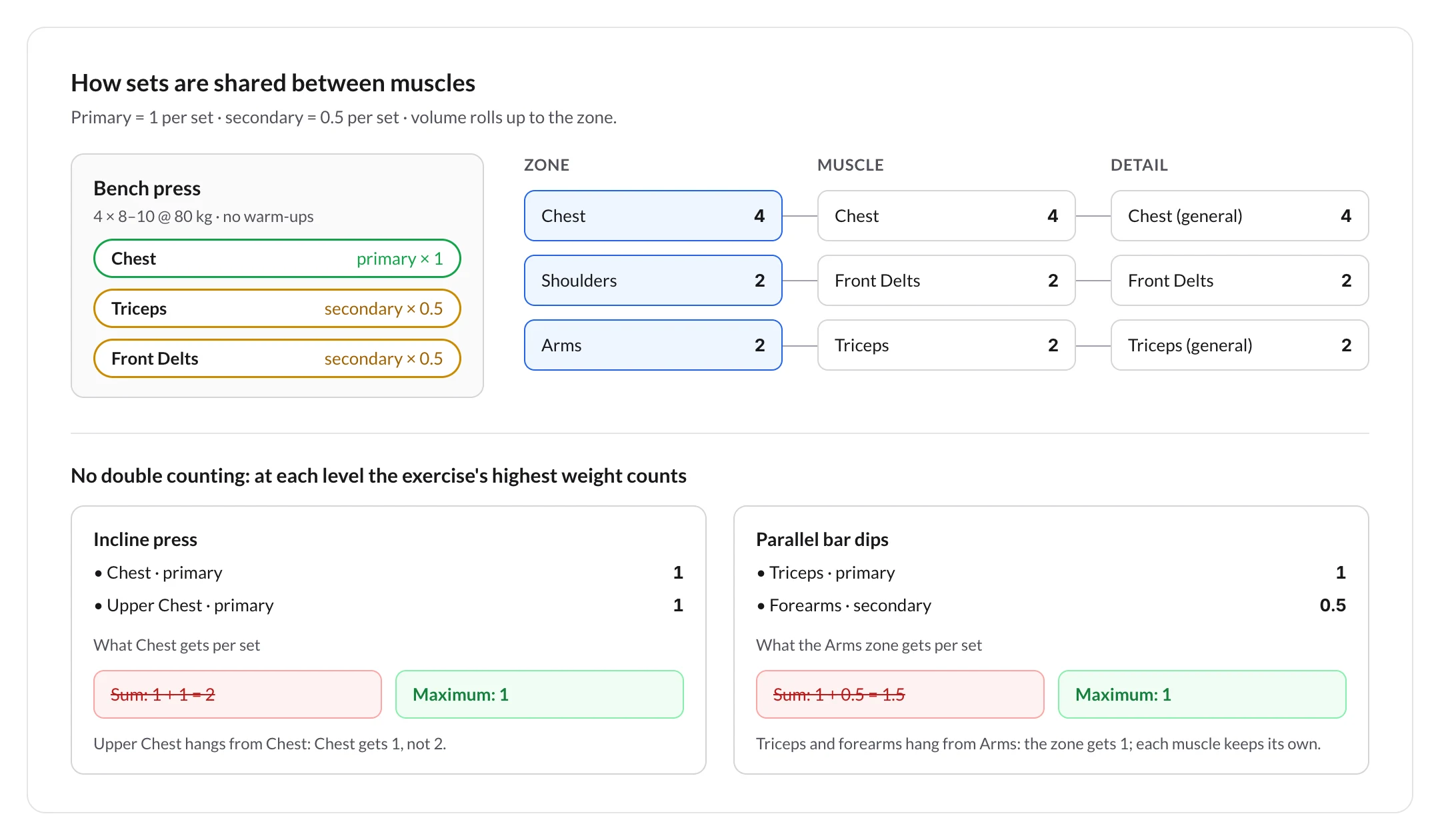
Primary 1, secondary 0.5
For each set, each primary muscle adds 1 and each secondary, 0.5. A 4-set bench press with chest as primary and triceps and front delts as secondary gives 4 to chest, 2 to triceps and 2 to front delts. Reps and tonnage are split the same way.
Zone, muscle and detail
- Zone: Chest, Back, Shoulders, Arms, Core, Glutes, Legs and Neck.
- Muscle: for example, Triceps within Arms.
- Detail: for example, the triceps long head.
What a muscle adds rolls up to its zone. If an exercise only says "Triceps", at Detail it shows as Triceps (general). Old muscle names are mapped to the current ones.
Nothing is counted twice
At each level, an exercise contributes the highest weight of its muscles in that group:
- Incline press with chest and upper chest as primary: Chest gets 1, not 2.
- Dips with triceps primary and forearms secondary: Arms gets 1, not 1.5 (triceps 1 and forearms 0.5 separately).
If one of your exercises has too many primary muscles, it will inflate them: review the classification of the ones you use most. Without muscles, it goes to Unclassified.
What counts as a set
The rules the workout analyzer uses to count sets — warm-ups, drop sets, supersets, circuits and AMRAPs, days with options, rep ranges and pound-to-kg conversion.
Worked examples
Workout analyzer examples with all the math done — sets, reps and tonnage for a bench press, chest and quad frequency and rest, a set with RPE and a triathlon week.