The plan starts from what your athlete runs today and builds to a peak week sized for their race. Miles and elevation gain (vert) climb gradually, every fourth week is a cutback week (70% of the week before), and the last two weeks drop the volume so they show up fresh.
It has four phases:
- Base (weeks 1 to 4). Easy runs, short 30-second hill repeats and general strength twice a week.
- Build (weeks 5 to 8). Longer hill repeats in zone 4, fartlek on rolling terrain and heavier strength work.
- Specific (weeks 9 to 14). Steady climbs, technical descents, back-to-backs and long runs on terrain like the race course.
- Taper (weeks 15 and 16). Less volume, a touch of race pace and the race on the final weekend.
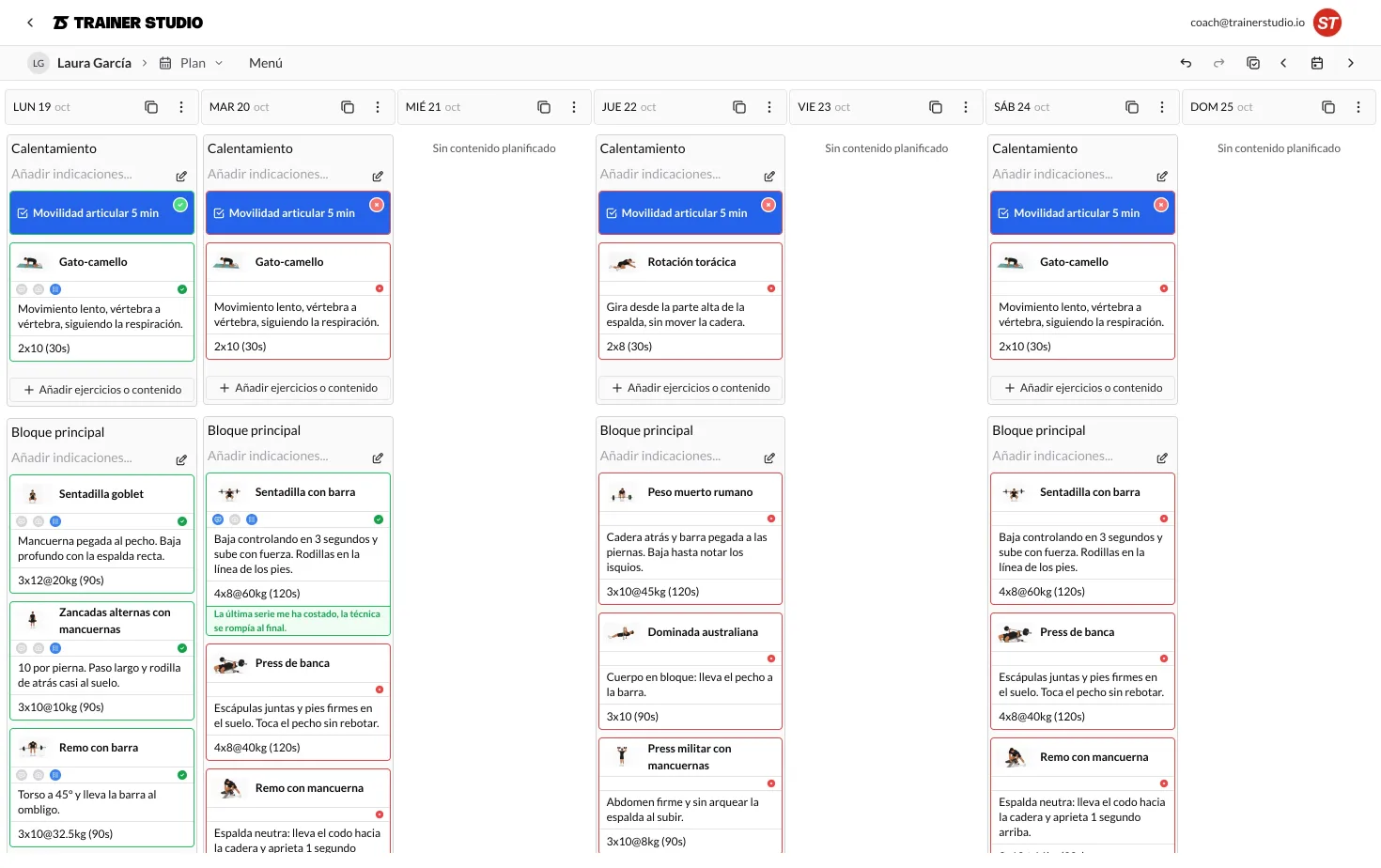
Typical week: rest on Monday and Friday, hills on Wednesday, two easy runs with strength, a long trail run on Saturday and an easy run or rest on Sunday. If your athlete trains on other days, move the sessions but keep the order: nothing hard the day before the long run.
On the Athlete sheet you enter the race distance and elevation gain, plus your athlete's average weekly miles and gain over the last four weeks. The spreadsheet works out:
- Race effort miles: every 500 ft of gain counts as 1 flat mile. A 20-mile trail race with 5,000 ft of gain comes to 30 effort miles.
- Suggested peak week: it aims for 1.3 times the race distance without going over 1.5 times current mileage. At 20 miles a week with a 20-mile race, the peak is 26 miles.
- Peak week elevation gain: the race's gain per mile applied to that week, capped at 1.2 times the race's gain. In the example, 6,000 ft.
If you know your athlete's history, type your own peak into the two green cells and the whole plan recalculates. If the race is longer than the peak week, the spreadsheet flags it: think about a shorter race or a longer build.
Every week has a long run, a hill session, strength and one more quality session. What sets them apart from road running:
- Long run. Measured in time on feet more than miles: an uphill mile can take three times as long. It stays in zone 2, and it's where gels, drinks, pack and shoes get tested.
- Hills. Short and hard in the base phase, 2 to 3 minutes in zone 4 in the build phase and steady climbs at race effort in the specific phase. Power hiking the steep pitches is a skill to train too.
- Downhills. They take technique and eccentric quad strength. Practice them under control, with short steps and eyes a few yards ahead.
- Back-to-backs. A long run, then 60 to 90 easy minutes the next day: it teaches running on tired legs without one huge long run.
Go by heart rate or perceived effort (RPE): on climbs and descents, pace per mile tells you nothing. The zones on the Athlete sheet use the Karvonen formula with their max and resting heart rate.
Two sessions a week in the base and build phases, one maintenance session in the specific phase and none in race week. The exercises in the plan:
- Step-ups onto a bench or box, driving up with one leg and lowering under control.
- Bulgarian split squats and single-leg Romanian deadlifts.
- Goblet squats and slow eccentric squats to get ready for the downhills.
- Calf raises with a straight and a bent knee.
- Single-leg glute bridges and front and side planks.
- Box jumps from the specific phase on.
Keep strength from leaving them sore on long run day: schedule it two days before or right after an easy run.
Elevation gain can be built without mountains:
- Treadmill on an incline: a mile at 10% is about 530 ft of gain.
- Stairs in a building or a stadium, power hiking up and stepping down carefully.
- Repeats on the longest hill, ramp or parking garage nearby.
- Step-ups with a loaded pack for the long climbs.
Save at least one long run a month for real trails, even if it means a drive, to practice downhill technique and gear.
Every Sunday, you or your athlete log the week's miles, elevation gain, total time and average effort (RPE from 1 to 10). The spreadsheet works out load as minutes × RPE (Foster's session RPE) and compares it with the week before.
Amber marks weeks that fall below 80% of the plan; red marks load that jumps more than 15% at once. Both are a reason to talk to your athlete and adjust the next week. A chart shows planned vs. completed miles.
Sources
- Karvonen MJ, Kentala E, Mustala O. The effects of training on heart rate; a longitudinal study. Ann Med Exp Biol Fenn. 1957;35(3):307-315.
- Foster C et al. A new approach to monitoring exercise training. J Strength Cond Res. 2001;15(1):109-115.











 @baumovment