

Training load calculator Enter the week's RPE. We'll give you the load and the ACWR.
Log an athlete's sessions with their minutes and RPE. You get the week's sRPE load, monotony, strain and, with the three previous weeks, the ACWR. Add today's Hooper questionnaire and we'll also tell you whether it's worth talking to the athlete before training.
How it's calculated Four numbers, with their formulas.
sRPE load
RPE × minutes
The session RPE (CR-10 scale) times its duration, in arbitrary units (AU). A 75-minute session at RPE 6 is 450 AU. The week's load is the sum of all its sessions.
Monotony and strain
monotony = daily average ÷ standard deviation strain = weekly load × monotony
Monotony measures how alike the days of the week are, with rest days at 0. Above 2, the week is very uniform. Strain combines that uniformity with the total load.
ACWR
this week's load ÷ average of the last 4
It compares acute load (this week) with chronic load (the average of the last four, including this one). Close to 1, the week looks like usual; well above it, there's a spike.
Hooper index
sleep + stress + fatigue + muscle soreness
Four questions from 1 to 7 every morning. The index runs from 4 to 28, and how it changes matters more than its value: an item at 6 or 7, or 4 points above usual, calls for a conversation.
The ACWR, with caution
The 0.8 to 1.3 range comes from team sport studies, and other work questions the method: the ratio shares data with its own denominator and doesn't predict injuries on its own. Use it to see how load changes and to ask questions, not to decide on it alone.
Sources: Foster et al. (2001), sRPE; Foster (1998), monotony and strain; Hooper and Mackinnon (1995), Hooper questionnaire; Gabbett (2016) and Impellizzeri et al. (2020), on the ACWR and its limits.
Keep going From today's numbers to tracking the whole season.
Training load template
A free Excel sheet with sRPE, ACWR, monotony, strain and Hooper wellness for the whole team, with charts.
Software for S&C coaches
We compared the apps for programming your athletes and tracking their load.
1RM calculator with RPE
Estimate the 1RM from a single set, its reps and its RPE or RIR.
Deload week guide
When load and fatigue call for a lighter week, and how to program it.
FAQ
Training load, answered
It's the session RPE multiplied by its minutes, in arbitrary units (AU). Foster proposed it in 2001, and it lets you compare very different sessions, on the field, in the gym or in a game, with a single number: 60 minutes at RPE 7 is 420 AU.
About 30 minutes after the session ends, with the question “How hard was your session?” and the CR-10 scale, from 0 (rest) to 10 (maximal). Asking right at the end tends to reflect only the last part of the session.
Divide this week's load (acute load) by the weekly average of the last four weeks, including this one (chronic load). This is the coupled rolling average version, the same one our template uses. There are other variants, such as the uncoupled one or exponentially weighted moving averages (EWMA), which give slightly different values.
It's often said that between 0.8 and 1.3 load is steady and that above 1.5 there's a spike. Those ranges come from team sport studies and the evidence is mixed: the ACWR does not predict injuries. Use it to spot sudden changes in load and to talk to the athlete, alongside their wellness and your own judgment.
Monotony is the week's average daily load divided by its standard deviation, counting rest days as 0: above 2, every day looks alike. Strain is the weekly load multiplied by monotony. Foster proposed both in 1998.
Four questions the athlete answers every morning, from 1 (very, very good) to 7 (very, very bad): sleep, stress, fatigue and muscle soreness. Their sum is the Hooper index, from 4 to 28. How it changes compared with each athlete's usual matters more than the value itself.
No. In TrainerStudio your clients log every set from their app, with its RPE, and in their profile you see planned and actual load, tonnage and minutes by day, week or month. For the ACWR, monotony and strain, use this calculator or the training load template.
For trainers and nutritionists only Tracking your athletes' load? Get their RPE without asking.


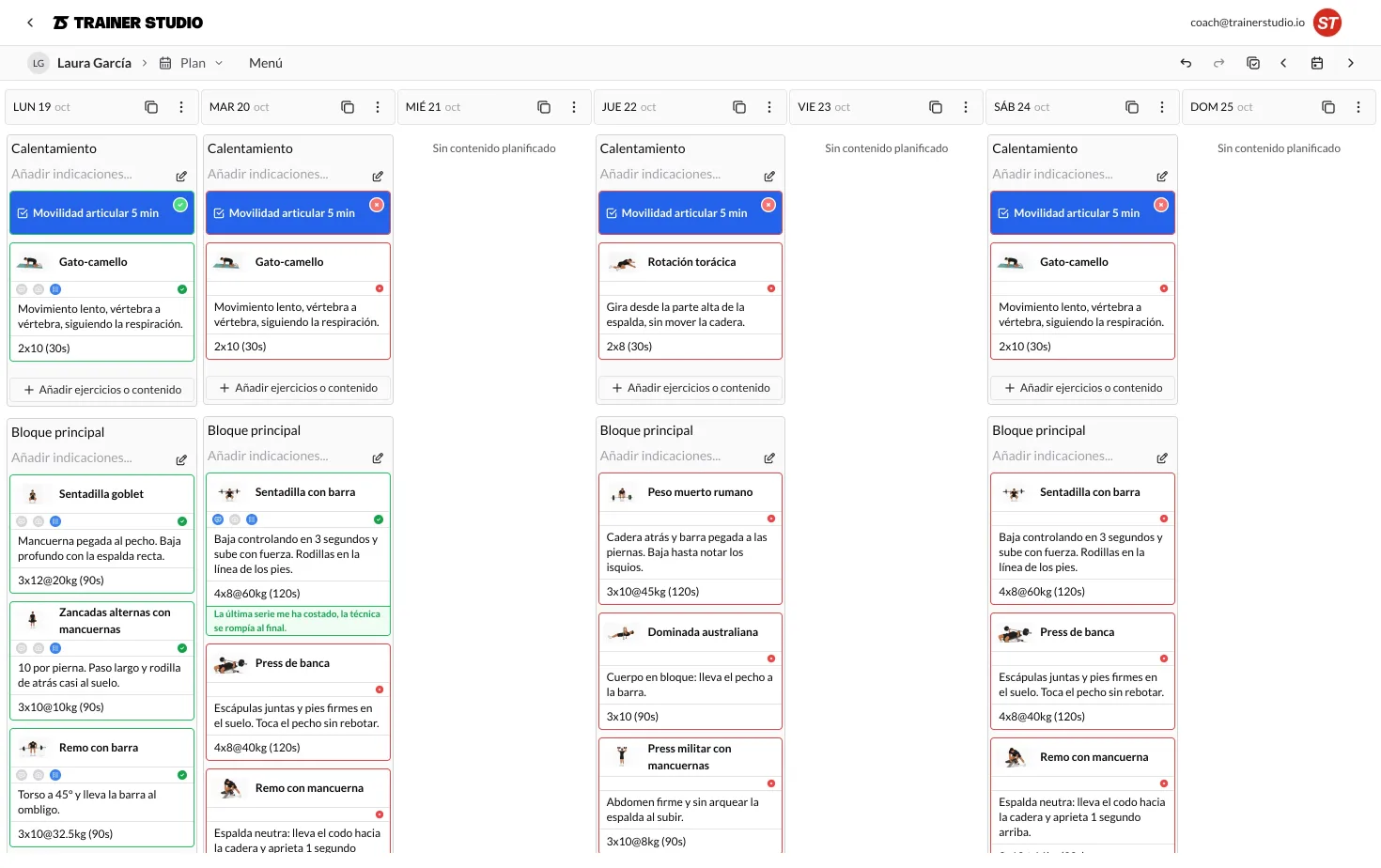
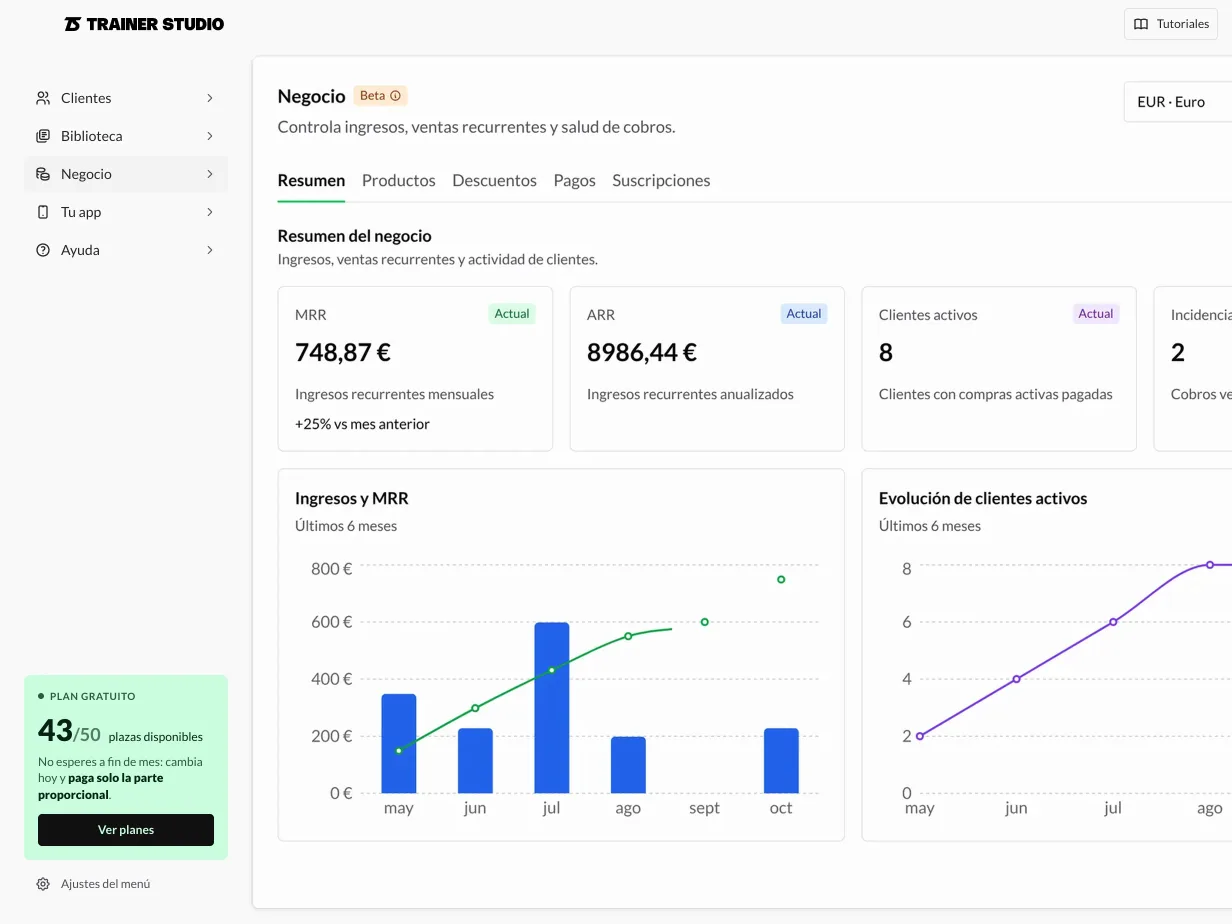
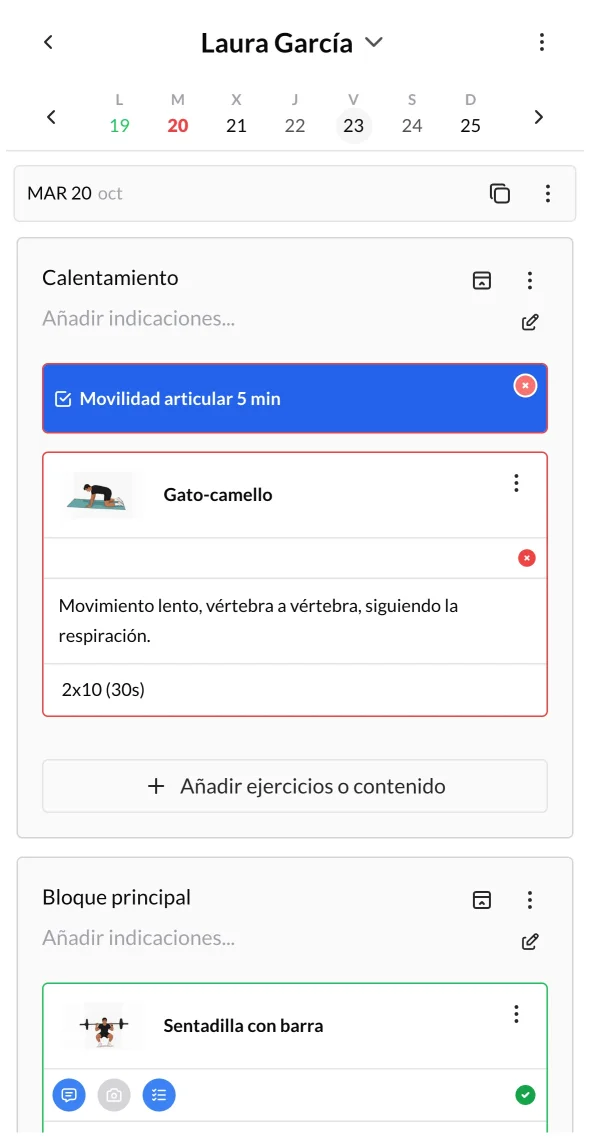
With TrainerStudio your clients log every set from their app, with its RPE. In their profile you see planned and actual load, tonnage and minutes by day, week or month, and compare what you programmed with what they did.
3 clients free forever · No card
Tracking your own load? Then you don't need TrainerStudio: the calculator and the template are free, no account needed.